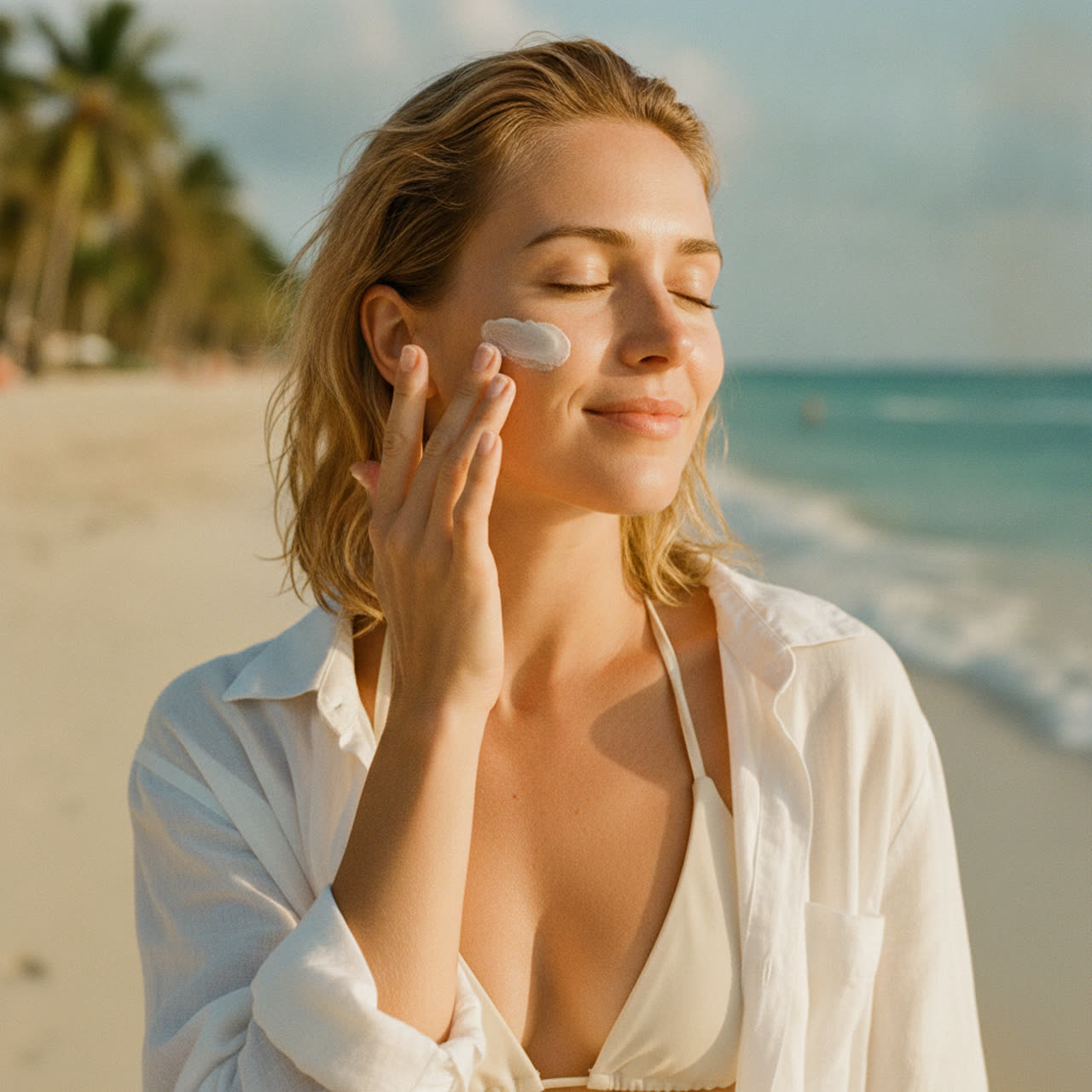
The uncomfortable truth about "aging" skin
We talk about skin aging as though it were purely a matter of years passing — an inevitable, internal clock ticking toward wrinkles. It is a comforting story, and it is largely wrong. Most of what we recognise as aged facial skin is not intrinsic aging at all; it is accumulated environmental damage, and overwhelmingly it is damage from the sun. Dermatologists commonly attribute on the order of 80% of visible facial aging to ultraviolet exposure rather than to chronological time.
There is an elegant way to see this for yourself, and it costs nothing. Compare the skin on your face or the backs of your hands — sun-exposed for a lifetime — with the skin on the inner side of your upper arm or your buttock, which almost never sees daylight. In the same person, of exactly the same age, the protected skin is smoother, firmer and more evenly coloured. That contrast is the difference between how skin ages and how skin is aged. It reframes the entire conversation: if the sun does most of the damage, then blocking the sun is not one anti-aging step among many — it is the foundation the rest are built on.
Photoaging versus chronological aging
It helps to separate two processes that unfold in the same skin. Chronological (intrinsic) aging is the slow, genetically programmed change that happens everywhere on the body over time: skin gradually thins, collagen production quietly declines from the mid-twenties, and fine lines appear. It is real, but on protected skin it is remarkably gentle — think of the fine, unblemished quality of skin that has spent decades under clothing.
Photoaging is the additional, and far more dramatic, damage layered on top wherever UV reaches. It produces a distinctive signature that a trained eye can spot instantly: deep coarse wrinkles rather than fine lines, a leathery or roughened texture, mottled pigmentation and dark spots, broken capillaries, and a sallow, yellowed slackness. When someone looks “weathered,” that word is doing real biological work — it is describing photoaging. The good news buried in this distinction is that the biggest, ugliest component of skin aging is the one most within your control.
The mechanism: how sunlight dismantles collagen
To respect a threat you need to understand it, and the biology of photoaging is now well mapped. Skin firmness rests on a dense scaffold of collagen in the dermis. Ultraviolet light attacks that scaffold in two ways: directly, by generating reactive oxygen species that damage cells and collagen, and — more insidiously — indirectly, by hijacking the skin's own maintenance machinery.
The landmark work here came from Fisher and colleagues, published in the New England Journal of Medicine. In carefully controlled experiments on human skin, they showed that a single exposure to ultraviolet light rapidly switched on a family of enzymes called matrix metalloproteinases — molecular scissors whose job is to cut up collagen. UV boosted three of these collagen-degrading enzymes, and the degradation of existing type I collagen rose by about 58% in irradiated skin compared with unexposed skin.[1] With repeated exposures, this collagen-cutting activity stayed elevated for days at a time.
Here is why that matters over a lifetime. Each sunny day, UV triggers a burst of collagen breakdown, and the skin tries to repair it — but the repair is imperfect and incomplete. Do that thousands of times across decades and you accumulate a slow, silent collagen deficit, laid down as disorganised, damaged tissue. The wrinkles and slackness you eventually see are the visible ledger of countless microscopic demolitions that were never fully rebuilt. Tellingly, in the same study, pre-treating the skin with topical tretinoin (a retinoid) inhibited the induction of those collagen-cutting enzymes by 70–80%[1] — a direct mechanistic clue to why retinoids are such effective anti-aging actives.
The evidence that prevention works: the Nambour trial
Mechanism tells you sun protection should help; only a trial can tell you it does. That trial exists, and it is unusually clean. In the Australian town of Nambour, Hughes and colleagues randomly assigned 903 adults under 55 to either daily, routine use of broad-spectrum sunscreen or to “discretionary” use — applying it whenever they normally would — and followed them for four and a half years, with skin aging graded by assessors blinded to which group people were in.[2]
The results, published in Annals of Internal Medicine, were striking in their clarity. The daily-sunscreen group showed no detectable increase in skin aging over the four and a half years. Compared with the discretionary-use group, they had 24% less photoaging (a relative odds of 0.76).[2] This is the sentence worth remembering: in a randomized controlled trial — the gold standard of evidence — regular sunscreen use measurably retarded skin aging in healthy, middle-aged men and women. Not a cell-culture hint, not a mouse, not a manufacturer's before-and-after, but a real human trial. (In the same study, a β-carotene antioxidant supplement showed no overall effect on skin aging — a reminder that the protection came from blocking the sun, not from a pill.)
What "good" sun protection actually means
If daily sunscreen is the highest-return move in skincare, it is worth doing properly — and most people underdo it. A few points separate real protection from the illusion of it:
- Broad-spectrum is non-negotiable. UVB (the burning wavelength) is only half the story; UVA penetrates more deeply, drives much of the collagen damage, and passes through window glass and cloud. A product must protect against both to slow photoaging.
- Daily, not just for the beach. The Nambour benefit came from routine, everyday use. Photoaging is a slow accumulation from ambient, incidental exposure — the walk to work, the drive, the seat by the window — not only from sunbathing.
- Enough, and reapplied. Most people apply a fraction of the amount used to test a sunscreen's SPF, which quietly slashes real-world protection. A generous layer, reapplied through prolonged exposure, is what delivers the labelled defence.
- Protection is more than a bottle. Shade, a wide-brimmed hat and avoiding peak midday sun are not old-fashioned advice; they are the same strategy by other means, and they compound the benefit.
Where sunscreen sits in a complete routine
Sun protection and active repair are two halves of one strategy, and the order matters. First you stop the breakdown: without daily UV defence, you are trying to fill a bath with the plug pulled out, because the sun keeps degrading collagen faster than any serum can rebuild it. Only once that demolition is slowed do the proven repair actives get to do their work on a fair footing.
Those actives are the ones with genuine randomised-trial evidence for rebuilding the skin's own collagen — chiefly the retinoids and vitamin C, which we cover in depth elsewhere. Nightly topical retinol has been shown to significantly improve fine and deep wrinkling in a vehicle-controlled trial,[3] and a 5% vitamin C cream produced clinical improvement in photoaged skin with microscope evidence of tissue repair.[4] Notice the elegant symmetry: retinoids partly work by suppressing the very collagen-cutting enzymes the sun switches on. Sun protection prevents the damage; retinoids and vitamin C help repair what is already done. Neither substitutes for the other.
The royal verdict
There is a quiet irony at the heart of the anti-aging industry. The most transformative, best-evidenced, longest-lasting intervention for keeping skin youthful is not a rare botanical or a luxury serum — it is the disciplined, daily habit of protecting skin from the sun. It is inexpensive, it is proven in a randomized controlled trial, and it addresses the cause of roughly four-fifths of the aging people spend fortunes trying to reverse.
Ageing beautifully, in the end, is less about what you add and more about what you stop allowing. Protect the skin from its single greatest ager, and every other step — the retinoid, the vitamin C, the peptide — works on a canvas that is no longer being quietly dismantled each day. That is not deprivation; it is the most sophisticated move in the whole routine.
Common questions
How much of skin aging is actually caused by the sun?
A large majority — dermatology commonly attributes on the order of 80% of visible facial aging (wrinkles, uneven pigmentation, loss of firmness, coarse texture) to ultraviolet exposure rather than to time itself. The clearest demonstration is to compare sun-exposed skin, like the face or backs of the hands, with rarely exposed skin such as the inner upper arm in the same person: the protected skin looks strikingly younger.
Does daily sunscreen really slow skin aging, or is that marketing?
It is proven in a randomized controlled trial. In the Australian Nambour trial, 903 adults were assigned to either daily broad-spectrum sunscreen or discretionary use over four and a half years. The daily-sunscreen group showed no detectable increase in skin aging and had 24% less photoaging than the discretionary group — direct human evidence that consistent sunscreen use retards skin aging in middle-aged adults.[2]
What is the biological mechanism behind sun-induced wrinkles?
Ultraviolet light switches on enzymes called matrix metalloproteinases that degrade the skin’s collagen. In a controlled study, even a single UV dose raised these collagen-cutting enzymes and increased breakdown of existing collagen by about 58% versus unexposed skin.[1] Repeated over years, this outpaces the skin’s ability to rebuild collagen, and the accumulated deficit shows up as wrinkles and slackness. Topical tretinoin blunted this enzyme induction by 70–80% in the same study.
References
- Fisher GJ, Wang ZQ, Datta SC, Varani J, Kang S, Voorhees JJ. Pathophysiology of premature skin aging induced by ultraviolet light. N Engl J Med. 1997;337(20):1419–1428. PubMed · doi:10.1056/NEJM199711133372003
- Hughes MC, Williams GM, Baker P, Green AC. Sunscreen and prevention of skin aging: a randomized trial. Ann Intern Med. 2013;158(11):781–790. PubMed · doi:10.7326/0003-4819-158-11-201306040-00002
- Kikuchi K, Suetake T, Kumasaka N, Tagami H. Improvement of photoaged facial skin in middle-aged Japanese females by topical retinol (vitamin A alcohol): a vehicle-controlled, double-blind study. J Dermatolog Treat. 2009;20(5):276–281. PubMed · doi:10.1080/09546630902973987
- Humbert PG, Haftek M, Creidi P, et al. Topical ascorbic acid on photoaged skin. Clinical, topographical and ultrastructural evaluation: double-blind study vs. placebo. Exp Dermatol. 2003;12(3):237–244. PubMed · doi:10.1034/j.1600-0625.2003.00008.x
Study data sourced via PubMed.