Why one obscure metabolite is suddenly everywhere
Every few years the longevity world falls for a new molecule, and most fade as quickly as they trended. Urolithin A is different, and the reason is worth stating plainly at the outset: it is one of the very few compounds in this crowded field to have moved out of the petri dish and the mouse cage and into randomized, placebo-controlled human trials — with results published in journals of the calibre of Nature Metabolism and JAMA Network Open. In a space awash with cell-culture hints and influencer certainty, that alone earns it a serious hearing.
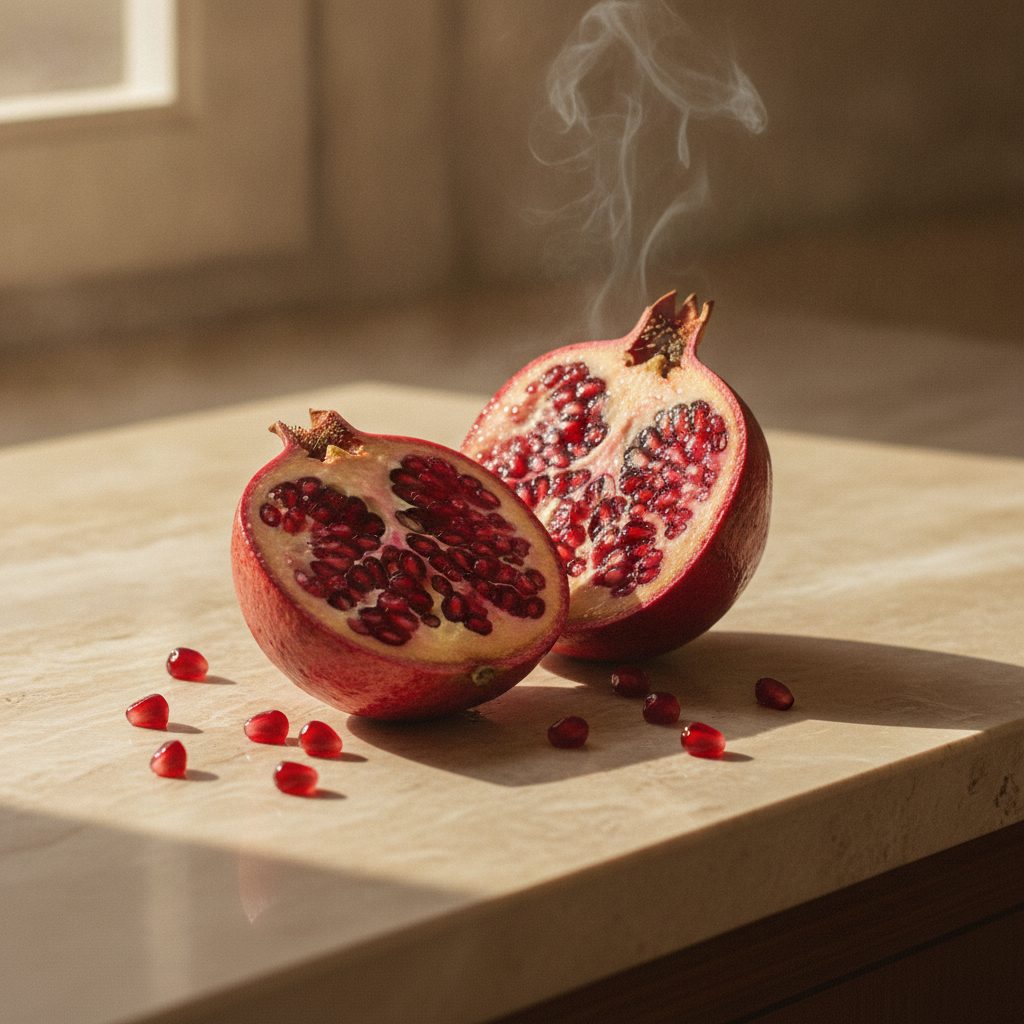
What makes the story elegant is where it begins: not in a laboratory, but at the table. Urolithin A is not something you eat. It is something your body makes — a metabolite produced when the bacteria in your gut break down a family of plant compounds called ellagitannins, found most famously in the pomegranate, and also in walnuts, raspberries and strawberries. The pomegranate's long association with vitality, it turns out, may have a molecular footnote.
The gut lottery: why the pomegranate alone may not be enough
Here is the inconvenient twist that reframes the whole subject. Eating pomegranates does not guarantee you any urolithin A at all. The conversion from ellagitannins to the active metabolite depends entirely on carrying the right gut bacteria — and researchers estimate that only around 30 to 40 percent of people harbour a microbiome capable of producing meaningful amounts. The rest, no matter how virtuously they eat, are effectively left out.
This is the elegant commercial logic behind the supplement version (marketed as Mitopure, and the form used in the clinical trials): rather than relying on the lottery of your gut flora, a standardised dose of urolithin A itself is delivered directly, bypassing the conversion step. It is a genuinely rational piece of nutritional science — identify the active molecule, measure who can make it, and supply it to those who cannot. Whether you need it is a separate question, and one we return to honestly below.
Mitophagy: the cellular housekeeping that fades with age
To understand why urolithin A matters, you have to understand mitochondria — the tiny power plants inside nearly every cell, which convert food and oxygen into usable energy. Like any hard-working machinery, mitochondria wear out. A young, healthy cell has a quality-control system for this: it identifies damaged mitochondria, dismantles them, and recycles the parts. That process has a name — mitophagy, a specialised form of the cellular self-cleaning known as autophagy, the discovery of which won the 2016 Nobel Prize in Medicine.
The problem is that mitophagy slows with age. Damaged, inefficient mitochondria accumulate; cells that once ran clean begin to sputter; and this cellular fatigue is now considered one of the hallmarks of biological aging, showing up first in energy-hungry tissues like muscle. This is the exact lever urolithin A pulls. In laboratory and animal work it has been shown to stimulate mitophagy — in effect, restarting the recycling programme — clearing out the faulty power plants so the cell can rebuild a healthier population. The appeal is easy to see: rather than adding something, it helps the cell resume housekeeping it used to do on its own.
The human evidence: what the trials actually show
Mechanism is seductive, but only trials settle whether a molecule earns its place. Urolithin A has three that matter, and reading them carefully is more instructive than any marketing page.
The foundation was laid by Andreux and colleagues, whose first-in-human study appeared in Nature Metabolism in 2019. In healthy, sedentary elderly volunteers, four weeks of urolithin A at 500 mg and 1000 mg was shown to be safe and bioavailable, and — crucially — it shifted the pattern of mitochondrial gene expression in skeletal muscle toward a healthier profile.[1] This did not prove people felt stronger; it proved the molecule reached the muscle and nudged the machinery in the intended direction. It was a proof of concept, and an honest one.
The most quotable result came in 2022, when Singh and colleagues published a four-month randomized, placebo-controlled trial in middle-aged adults in Cell Reports Medicine. Here the daily supplement produced a significant improvement in muscle strength of roughly 12 percent, alongside gains in aerobic endurance and reductions in plasma markers of inflammation and mitochondrial inefficiency.[2] A 12 percent strength gain from a pill is a genuinely notable figure — and it is exactly the sort of number that fuels a trend.
The third trial, by Liu and colleagues in JAMA Network Open, tested a higher dose in older adults aged 65 to 90 over four months. It found that urolithin A was safe and improved muscle endurance — the number of contractions before fatigue — and favourably shifted plasma biomarkers of cellular health.[3] Taken together, three human trials point the same way: better mitochondrial biomarkers, and modest but real gains in muscle function in aging adults.
The honesty clause: where the evidence stops
An article that stopped there would be doing you a disservice, because the same trials contain their own cautions — and a molecule is only as trustworthy as the limitations you are told about.
In the JAMA Network Open study, the two primary endpoints — six-minute walk distance and maximal ATP production in the hand muscle — did not reach statistical significance versus placebo; the encouraging results were in the secondary measures.[3] In the middle-aged trial, peak power output, the pre-registered primary endpoint, likewise was not significantly improved.[2] And a 2025 trial in highly trained distance runners found that four weeks of urolithin A aided recovery and lowered markers of muscle damage but did not improve race performance in already-elite athletes.[4] A systematic review of supplements and mitochondria in healthy older adults reached a measured verdict: the signals are positive, but the number of rigorous human studies remains small.[5]
The fair summary, then, is this. Urolithin A is not snake oil — it has cleared bars most supplements never approach. But it is not a transformation either. The effects are moderate, they are clearest in aging or sedentary muscle rather than in the already-fit, and the long-term data across years, not months, does not yet exist. It is worth noting, too, that much of the pivotal research has been conducted or funded by the company that commercialised the molecule — not a disqualification, but a reason to welcome the independent trials now emerging.
How it fits a considered longevity ritual
Where does this leave the discerning reader? With a molecule that is interesting rather than essential — and that is a perfectly respectable place for it to sit. A few points frame it sensibly:
- Food first, always. Pomegranates, walnuts and berries are worth eating for reasons far beyond urolithin A — polyphenols, fibre and fashionless nutritional virtue. If you are among the minority who convert efficiently, you may already make your own.
- The trial doses were specific. Human studies used 500 to 1000 mg of standardised urolithin A daily. Eating pomegranate does not reliably reproduce that, which is the honest case for the supplement — and the reason a glass of juice is not the same intervention.
- It targets energy, not the mirror. The proven benefits are in muscle and mitochondrial function. Direct, high-quality human trials on skin aging are still emerging, so treat skin claims as promising theory rather than settled fact.
- It complements, never replaces. No metabolite outranks the unglamorous fundamentals — sleep, resistance training, protein, and daily sun protection. Urolithin A is a possible refinement at the edges of an already-sound routine, not its foundation.
The royal verdict
There is a particular elegance to urolithin A that fits the Longevity Royal philosophy: it does not add a foreign substance so much as it helps the body resume something it once did effortlessly — the quiet, constant renewal of its own cellular machinery. That is a more sophisticated idea than most of what the supplement aisle sells, and the human trials give it a credibility its rivals lack.
But sophistication is not the same as necessity. The honest verdict is that urolithin A is a genuinely promising molecule with real, if moderate, evidence behind it — best considered as a thoughtful addition once the foundations of beautiful aging are already in place, and best approached with the same evidence-first scepticism we bring to everything. Age beautifully by building the base first. Then, if you wish, refine.
Common questions
What is urolithin A and where does it come from?
Urolithin A (chemical formula C13H8O4) is not found directly in food. It is made in the gut when bacteria break down ellagitannins and ellagic acid — compounds abundant in pomegranates, walnuts, raspberries and strawberries. Only an estimated 30–40% of people carry the gut bacteria to produce meaningful amounts, which is why standardised supplements were developed to deliver it directly.
Does urolithin A actually work in humans, or only in animals?
There is genuine human evidence, which is rare for a longevity molecule. A first-in-human trial in Nature Metabolism showed it is safe and shifts skeletal-muscle gene expression toward better mitochondrial health.[1] A later randomized trial in middle-aged adults reported about a 12% gain in muscle strength,[2] and a trial in adults aged 65–90 found improved muscle endurance.[3] Some primary endpoints were not met, so the picture is promising but not a cure-all.
What is a typical urolithin A dose and is it safe?
The human trials used 500 mg to 1000 mg per day for four weeks to four months and reported a favourable safety profile with no serious attributable adverse effects.[1] Long-term safety over many years has not been established, so anyone pregnant, breastfeeding, or taking medication should consult a doctor before supplementing.
References
Study data sourced via PubMed.
- Andreux PA, Blanco-Bose W, Ryu D, et al. The mitophagy activator urolithin A is safe and induces a molecular signature of improved mitochondrial and cellular health in humans. Nat Metab. 2019;1(6):595–603. PubMed · doi:10.1038/s42255-019-0073-4
- Singh A, D'Amico D, Andreux PA, et al. Urolithin A improves muscle strength, exercise performance, and biomarkers of mitochondrial health in a randomized trial in middle-aged adults. Cell Rep Med. 2022;3(5):100633. PubMed · doi:10.1016/j.xcrm.2022.100633
- Liu S, D'Amico D, Shankland E, et al. Effect of urolithin A supplementation on muscle endurance and mitochondrial health in older adults: a randomized clinical trial. JAMA Netw Open. 2022;5(1):e2144279. PubMed · doi:10.1001/jamanetworkopen.2021.44279
- Whitfield J, McKay AKA, Tee N, et al. Evaluating the impact of urolithin A supplementation on running performance, recovery, and mitochondrial biomarkers in highly trained male distance runners. Sports Med. 2025;55(12):3183–3200. PubMed · doi:10.1007/s40279-025-02292-5
- Lippi L, Uberti F, Folli A, et al. Impact of nutraceuticals and dietary supplements on mitochondria modifications in healthy aging: a systematic review of randomized controlled trials. Aging Clin Exp Res. 2022;34(11):2659–2674. PubMed · doi:10.1007/s40520-022-02203-y