The molecule hiding inside your dinner
Every serious longevity conversation eventually circles back to a single, unglamorous idea: the body ages, in part, because its cells stop clearing away their own rubbish. Damaged proteins accumulate, spent mitochondria linger, and the cellular housekeeping that keeps a young cell tidy slows to a crawl. Fasting, exercise and caloric restriction all extend healthspan in animals largely because they reawaken this housekeeping. What is remarkable is that a single molecule, quietly present in wheat germ and aged cheese, appears to pull the same lever — without a single skipped meal.
That molecule is spermidine. It has none of the marketing sheen of the fashionable peptides, yet it may be one of the most robustly supported natural compounds in the entire longevity field — and in 2026 it has returned to the headlines for an entirely new reason: rescuing the aging immune system.
What spermidine actually is
Spermidine (chemical formula C7H19N3) belongs to a family of small, positively charged molecules called polyamines, alongside its cousins putrescine and spermine. First identified — as the name candidly admits — in seminal fluid, it is in fact present in every living cell, from bacteria to human neurons, where it helps stabilise DNA, regulate ion channels and orchestrate the recycling machinery of the cell.[1] It is both made by our own cells and produced by the bacteria of the gut, and it arrives daily on the plate.
The catch, and the reason it matters for aging, is that spermidine levels decline as we grow older in many tissues.[1] That decline is one of the threads that links spermidine to the biology of aging itself — and it is precisely the pattern that first drew researchers to ask whether topping it back up might matter.
Autophagy: the self-cleaning at the heart of it
To understand why spermidine is interesting, you have to understand autophagy — from the Greek for “self-eating.” It is the elegant process by which a cell packages up its damaged components, breaks them down and reuses the parts. A young cell does this briskly; an old one does it poorly, and the debris that builds up is now considered a hallmark of aging. Autophagy is the mechanism behind much of what makes fasting and exercise good for you, and its discovery earned a Nobel Prize in 2016.
Spermidine's headline act is that it induces autophagy directly, which has earned it the label of a “caloric-restriction mimetic” — a molecule that persuades cells they are fasting when they are not.[2] This places spermidine in the same conceptual neighbourhood as some of longevity's most studied interventions, and it is the reason the same molecule keeps reappearing across seemingly unrelated findings: the heart, the immune system, the aging brain. They are all, in the end, stories about cellular housekeeping.
The animal case: longer life and a protected heart
The pivotal work came in 2016, when a large European consortium led by Eisenberg and Madeo reported in Nature Medicine that feeding spermidine to mice extended their lifespan and, strikingly, protected the aging heart — reducing the stiffening and enlargement that accompany cardiac aging and preserving the heart's ability to relax and fill.[2] The animals showed enhanced cardiac autophagy and better mitochondrial function, and their blood pressure fell.
The most persuasive detail was a control experiment. When the researchers used mice genetically engineered to lack Atg5, a protein essential for autophagy, spermidine's cardioprotection simply vanished.[2] That is the kind of result that separates a genuine mechanism from a hopeful correlation: switch off the proposed pathway, and the benefit disappears with it. Spermidine was not merely associated with a healthier heart — it was working through autophagy to produce one.
The human signal: a diet that tracks with a longer life
Animal lifespan data are necessary but never sufficient. What lifts spermidine above most longevity candidates is that the human epidemiology points the same way. In the same 2016 paper, people reporting higher dietary spermidine had lower blood pressure and less cardiovascular disease.[2] Two years later, the same group published a dedicated analysis of the Bruneck study — a meticulously followed community cohort in northern Italy — in the American Journal of Clinical Nutrition.[3]
Following 829 people over twenty years, they found that those in the top third of spermidine intake had markedly lower all-cause mortality than those in the bottom third. The size of the gap was arresting: the difference in mortality risk between the highest and lowest spermidine intakes corresponded to being roughly 5.7 years younger.[3] The finding held after adjusting for lifestyle and other dietary factors, and was independently reproduced in a second Austrian cohort. For a single nutrient, that is an unusually strong human signal.
The honest framing matters here. These are observational studies: people who eat more spermidine-rich whole foods may simply live healthier lives in ways a questionnaire cannot fully capture. Correlation of this quality justifies serious interest and formal trials — it does not, on its own, prove cause. That distinction is the difference between a durable longevity insight and a viral one.
The 2026 news: rejuvenating the aging immune system
This is why spermidine is back in the feed. In 2026, a team at the University of Oxford published a double-blind, randomised, placebo-controlled pilot trial in Aging Cell that tackled one of aging's cruellest features: the immune system's decline, or immunosenescence, which is why vaccines protect older people less well.[4]
Forty healthy adults over 65 took either 6 mg of spermidine or placebo daily for thirteen weeks following a COVID-19 booster. The supplement was well tolerated. Among those whose immune systems had responded poorly to the vaccine — the frailest responders, marked by a distinct signature of senescent, worn-out lymphocytes — spermidine reversed key aging markers in those cells and significantly boosted their spike-specific antibodies, memory B-cell recall and neutralising antibody activity.[4] Single-cell sequencing confirmed the mechanism: spermidine had switched autophagy back on inside the immune cells.
It is important to hold this result at its true weight. This was a pilot study of forty people, designed principally to test safety and to generate hypotheses, not to change medical practice. But it is a rare and elegant demonstration in humans that a food-derived molecule can measurably rejuvenate a specific, clinically important feature of aging — and it points directly at the larger trials the field now needs.
The honest limitation: what spermidine did not do
A discerning reader is right to ask where the evidence pushes back, because it does. The most instructive counterweight is the SmartAge trial, published in JAMA Network Open in 2022.[5] Over a full twelve months, one hundred older adults with subjective memory complaints took a spermidine-rich wheat-germ supplement or placebo. The result was clean and disappointing: spermidine produced no significant improvement in memory over placebo.[5]
The authors noted possible hints of benefit for verbal memory and inflammation in exploratory analyses, and reasonably suggested that the modest dose may have been too low. But the headline is what matters for honesty: a well-run, year-long human trial found spermidine did not sharpen the aging mind. Set beside the promising immune and cardiovascular data, this is the field working as it should — a molecule that helps in some systems is not a panacea for all of them, and the disciplined position is to follow the evidence system by system rather than granting a blanket promise.
How to actually get more spermidine
For anyone building a considered regimen, the sensible reading of the evidence is elegantly old-fashioned: reach for the food before the pill.
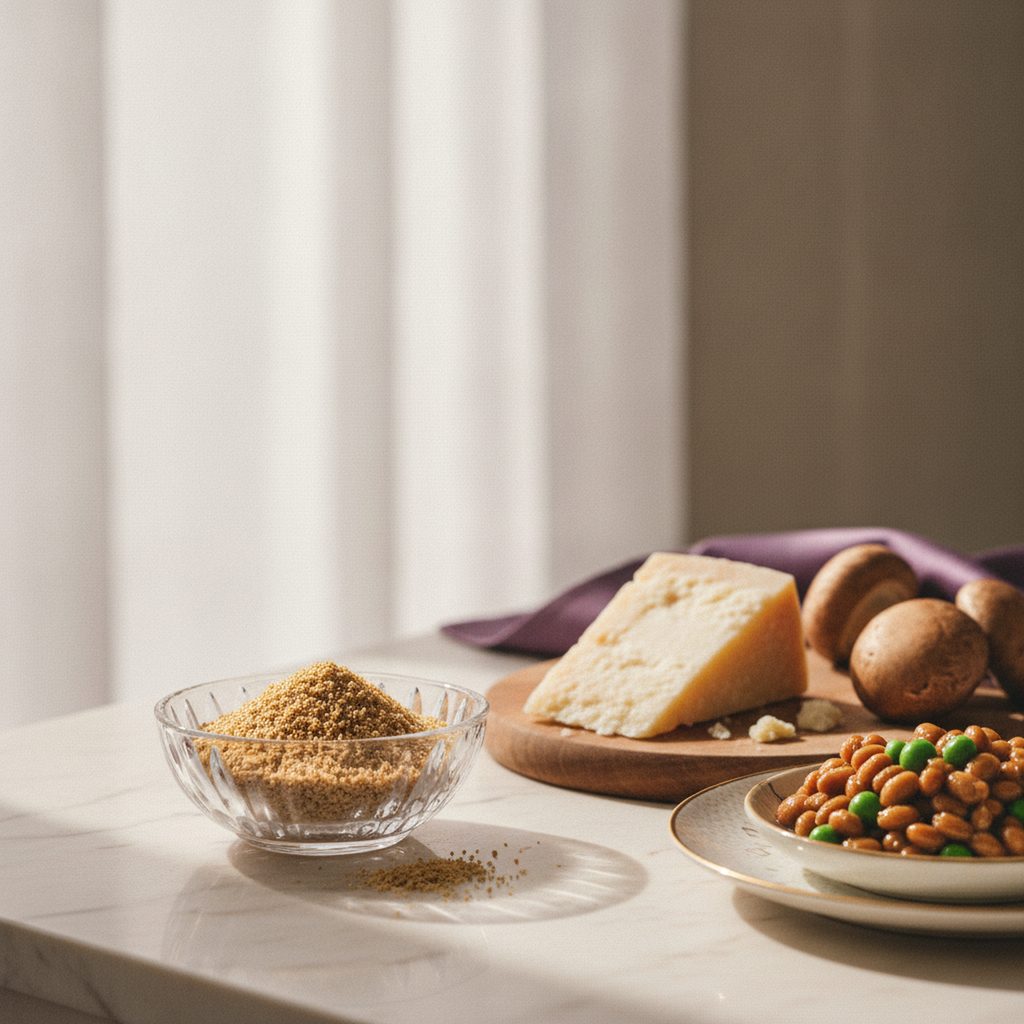
- Food first, and the food is unglamorous. The richest source is wheat germ; after that come aged and mature cheeses, mushrooms, soybeans and fermented soy such as natto, green peas and other legumes, and whole grains. The very cohorts that produced the strongest mortality data measured spermidine from ordinary diets like these.[3]
- The supplements are wheat-germ extracts. Most spermidine capsules are simply concentrated wheat germ. Human trials have used roughly 1 to 6 mg a day and found them well tolerated over months to a year.[4][5]
- It complements, it does not replace. Spermidine appears to work by nudging autophagy — the same pathway favoured by good sleep, regular movement and not overeating. It is best thought of as one refined addition to those proven foundations, never a substitute for them.
- Certainty is still pending. The definitive, long, large randomised trials measuring hard outcomes have not yet reported. Until they do, spermidine deserves genuine interest and measured expectations in equal part.
The royal verdict
Spermidine is the rare longevity story that improves the more closely you examine it. It has a clear, Nobel-adjacent mechanism in autophagy; lifespan and cardioprotection data in mice that survive the acid test of genetic control; human epidemiology strong enough to equate a spermidine-rich diet with years of biological age; and now, in 2026, a first human glimpse of a rejuvenated immune system. That it is also present in something as humble as wheat germ only deepens the appeal.
And yet the Longevity Royal position remains unhurried, precisely because the molecule earns that patience. The most compelling human data are observational, one clean trial found no benefit for memory, and the decisive studies are still to come. The refined approach is not to await certainty before living well, but to build on what is already beyond dispute — a diet rich in whole foods, deep sleep, daily movement — and to let spermidine take its place as an elegant, evidence-shaped guest at that table. Age beautifully by keeping the house clean, from the cell outward.
Common questions
What does spermidine do for longevity?
Spermidine (chemical formula C7H19N3) is a natural polyamine that switches on autophagy, the cell's self-cleaning process that clears damaged proteins and worn-out mitochondria and slows with age.[2] In mice, oral spermidine extends lifespan and protects the aging heart, and this benefit disappears when autophagy is genetically blocked.[2] In humans, higher dietary spermidine has been linked in large cohort studies to lower mortality and blood pressure,[3] and a 2026 Oxford trial found it rejuvenated aging immune cells.[4] The strongest human data are observational, so spermidine is a genuinely promising longevity molecule rather than a proven one.
Which foods are highest in spermidine?
The richest dietary source is wheat germ, which is why most supplements are wheat-germ extracts. Other good sources include aged and mature cheeses, mushrooms, soybeans and fermented soy such as natto, green peas and other legumes, and whole grains. A traditional Mediterranean-style diet rich in these foods naturally supplies a meaningful daily dose, which is how the large European cohort studies measured spermidine intake in the first place.[3]
Is spermidine safe to take as a supplement?
In human trials, spermidine-rich wheat germ extracts of roughly 1 to 6 milligrams per day for three months to a year have been well tolerated, with side effects no different from placebo.[4][5] That said, long-term safety over many years has not been established, the strongest longevity data come from food intake rather than high-dose pills, and anyone who is pregnant, breastfeeding, has a medical condition or takes medication should speak to a doctor before supplementing.
References
Study data sourced via PubMed.
- Schibalski RS, Shulha AS, Tsao BP, et al. The role of polyamine metabolism in cellular function and physiology. Am J Physiol Cell Physiol. 2024;327(2):C341–C356. PubMed · doi:10.1152/ajpcell.00074.2024
- Eisenberg T, Abdellatif M, Schroeder S, et al. Cardioprotection and lifespan extension by the natural polyamine spermidine. Nat Med. 2016;22(12):1428–1438. PubMed · doi:10.1038/nm.4222
- Kiechl S, Pechlaner R, Willeit P, et al. Higher spermidine intake is linked to lower mortality: a prospective population-based study. Am J Clin Nutr. 2018;108(2):371–380. PubMed · doi:10.1093/ajcn/nqy102
- Alsaleh G, Ali M, Kayvanjoo AH, et al. Spermidine mitigates immune cell senescence and boosts vaccine responses in healthy older adults — a pilot study. Aging Cell. 2026;25(6):e70545. PubMed · doi:10.1111/acel.70545
- Schwarz C, Benson GS, Horn N, et al. Effects of spermidine supplementation on cognition and biomarkers in older adults with subjective cognitive decline: a randomized clinical trial. JAMA Netw Open. 2022;5(5):e2213875. PubMed · doi:10.1001/jamanetworkopen.2022.13875